
Some links in this post may be affiliate links. We earn a small commission if you buy, at no extra cost to you.
Castillo de San Marcos, St. Augustine, Florida
Some places carry their history lightly. Castillo de San Marcos is not one of them.
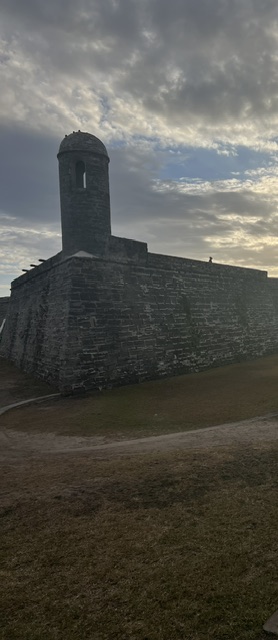
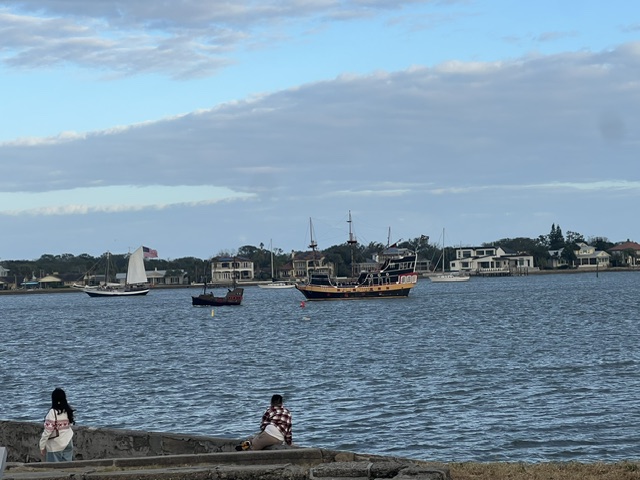
Standing at the edge of Matanzas Bay, the oldest masonry fort in the continental United States doesn’t announce itself the way modern landmarks do. It simply stands – massive, silent, and patient – the way something that has survived 350 years of siege, war, imprisonment, and death tends to stand. You feel it before you understand it.
Walking through the entrance, the walls close around you. Coquina stone – a uniquely Florida material made of compressed shells and coral – absorbs the light differently than brick or granite. It gives the fort its strange, almost organic quality, as if the walls themselves are alive. Those walls also absorbed something else: centuries of suffering.
Built to Endure
The Spanish began construction in 1672, and what they built was nearly indestructible. During a 50-day siege by English forces, the rest of St. Augustine burned to the ground. The Castillo didn’t fall. Cannonballs fired at its walls didn’t shatter the coquina – they embedded into it, absorbed like stones thrown into mud. The English eventually gave up and left. The fort remained.
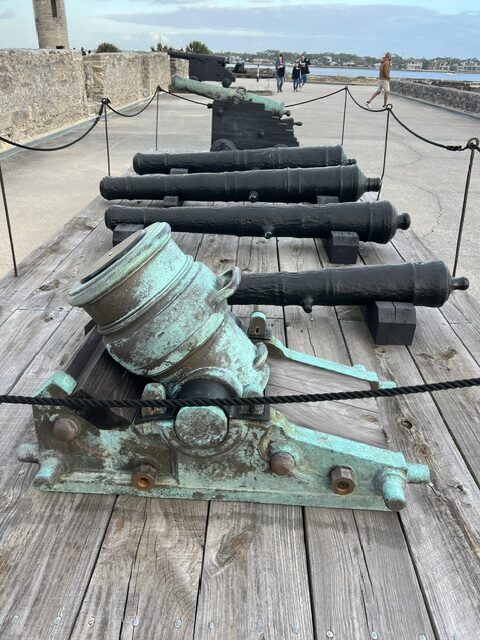
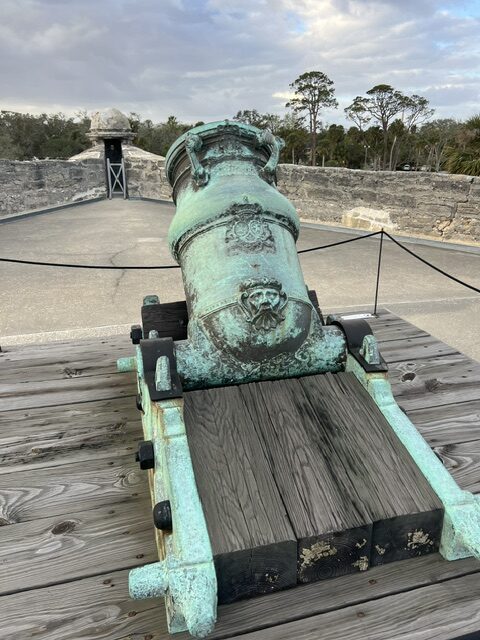
Standing on the upper gun deck, looking down the barrel of a centuries-old cannon, it’s impossible not to think about what it meant to be on the receiving end of one of those shots.
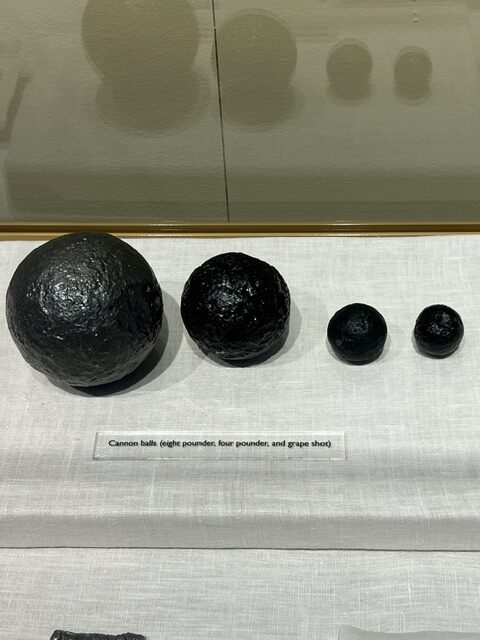
The cannon balls on display inside – eight-pounders, four-pounders, grape shot – are deceptively simple objects. Cold, black, heavy.
The damage they did was anything but simple.
What the Walls Witnessed
The fort changed hands multiple times – Spanish, British, Spanish again, then American. Each era left its mark. Inside, the rooms show how soldiers actually lived: cramped, dim quarters that feel less like barracks and more like cells. The ceilings press down. The air thickens. Some rooms have no windows at all, and stepping into them on a bright Florida afternoon, you’ll feel the temperature drop and something harder to name – a weight, a stillness, a sense that the darkness here has memory.
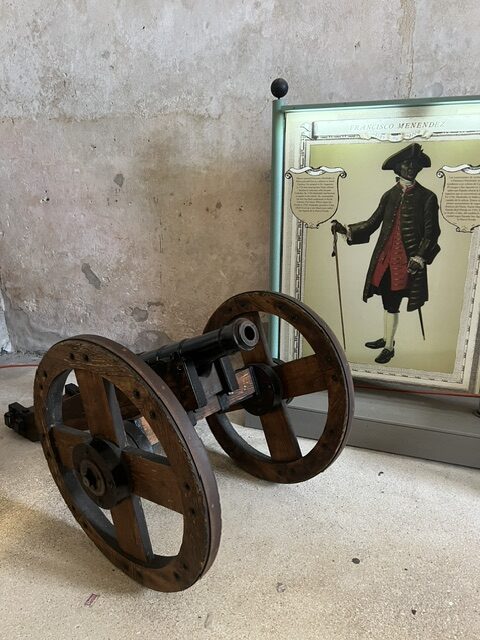
Soldiers felt it too, apparently. Deep in the inner walls, carved graffiti left by soldiers who were stationed here still marks the coquina – names, dates, small desperate proofs that someone was here, that someone existed. Walking past them feels like reading a message from the dead.
The fort also held prisoners, including, in the 1800s, Native American leaders taken captive during the Indian Wars. Men like Osceola, the Seminole warrior, were imprisoned in forts like this one as the U.S. government systematically dismantled the world they’d known. Fort Fraser, further inland, held Seminole prisoners too. The walls that kept invaders out kept them in.
The Dead Who Never Left
St. Augustine is considered one of the most haunted cities in America, and the Castillo is its darkest chapter.
The most infamous story involves a Spanish colonel, his wife Dolores, and a young captain named Manuel. When the colonel discovered the affair, the punishment he chose was not a duel or an exile. It was worse. The two were reportedly walled up alive inside a secret dungeon – sealed into the coquina and left to die in the dark.
Whether the story is literally true is debated. What visitors report is harder to dismiss. The scent of perfume – faint, floral, distinctly out of place – drifting through rooms where no one wears it. A figure, young, in period dress, glimpsed and then gone. Manuel, some say, still walks the fort looking for a way out.
He’s not alone. On the upper battlements, witnesses have reported a spectral sentry – a soldier in colonial dress, pacing with a lantern, performing his watch across centuries. On the gun decks, there are accounts of a headless soldier, standing at his post.
Step into one of the darker interior rooms and the temperature drops noticeably. It could be the coquina, the thick walls, the lack of airflow. It probably is. But standing in the dark, in a room where men were imprisoned and possibly entombed, the rational explanation feels insufficient.
What You’ll Find Today
The Castillo de San Marcos is a National Monument, open to visitors and remarkably well-preserved. The cannons are the first thing that stops you – lined up along the gun deck, green with centuries of patina, still aimed at the bay. The watchtower rises above everything, birds circling its open window against the Florida sky.
The museum rooms are worth your time. The exhibits are dense with history – maps, weapons, accounts of the sieges. But the real experience is quieter than any exhibit. It’s standing in a cramped stone room and feeling the weight of everything those walls have held. It’s running your hand along coquina that absorbed cannonballs and wondering what else it absorbed.
St. Augustine calls itself the oldest city in America. The Castillo is its oldest wound – still open, still haunted, still standing.
Some places carry their history lightly.
This is not one of them.
Practical Info:
Castillo de San Marcos National Monument
- Address: 1 S Castillo Dr, St. Augustine, FL 32084
- Hours: Daily 9am-5pm (closed Christmas Day)
- Admission: $15 adults, free under 15 with paid adult
- Parking: Street parking and nearby paid lots on the bayfront
Further Reading:
We came across an account of the hauntings here that we haven’t been able to shake, Haunted Lovers: Ghosts of Castillo de San Marcos by M. Jordan.
If you’re drawn to the same unresolved feeling we are, it’s worth a read.