
Some links in this post may be affiliate links. We earn a small commission if you buy, at no extra cost to you.
A quiet marker stands in Polk County today. A Fort Meade Florida historical marker is all that remains of the original 1849 outpost. Most drivers pass it without slowing down. It reads simply: Site of Fort Meade. Beneath that, a story most Florida history books skip entirely.
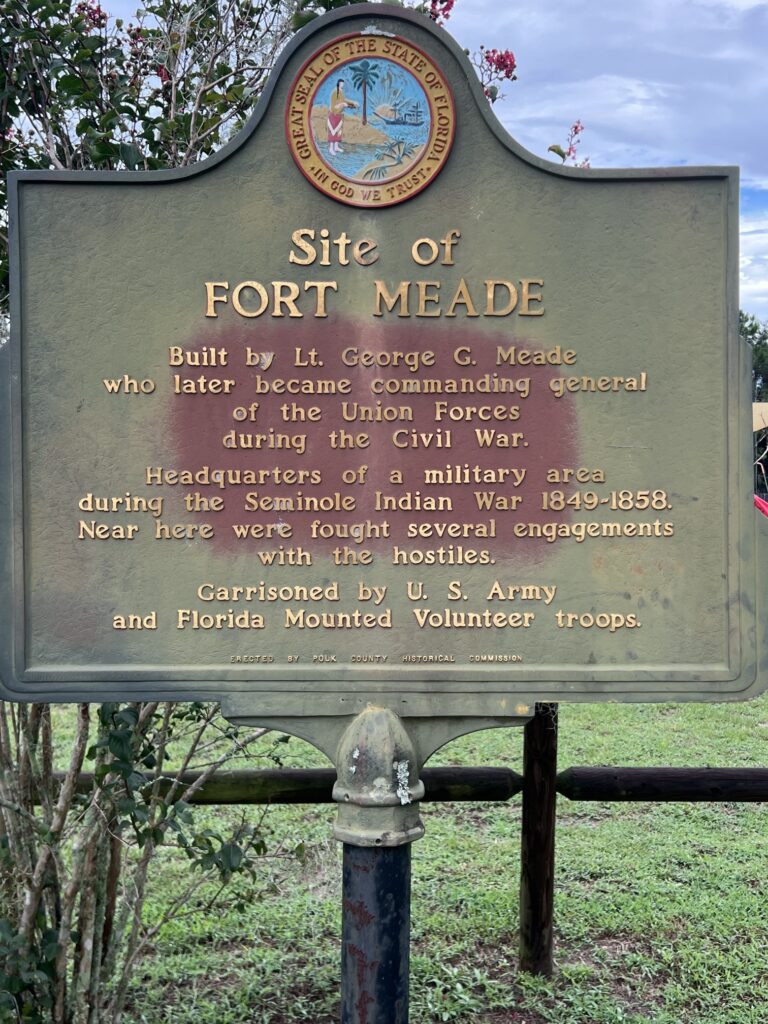
In 1849, a young Army lieutenant named George Gordon Meade came to this stretch of central Florida to help build a fort and a military road connecting Fort Brooke in Tampa to Fort Pierce on the east coast. According to Legends of America, Meade directed nine companies drawn from the 1st U.S. Artillery and the 3rd, 4th, and 7th U.S. Infantry in the construction. The Seminole Wars were dragging into their final, bitter phase. When the post was finished, Meade’s commanding officer named it after him, giving credit to the man who had surveyed and sited the ground.
Fourteen years later, that same man stood on a ridge in Pennsylvania and commanded the Army of the Potomac at Gettysburg. He is the reason the Confederacy never crossed the Mason-Dixon line again.
But Meade was not the only future general who passed through this fort.
A year after Meade left, a different lieutenant arrived. His name was Thomas Jonathan Jackson. The historical marker erected at the site by the Gen. E. M. Law Camp, Sons of Confederate Veterans, and documented by the Historical Marker Database, states that Jackson served here as a 1st Lieutenant with Company E, 1st U.S. Artillery, from December 1850 through May 1851. He was not yet a legend. He was a young officer stationed in the Florida wilderness, doing the unglamorous work that came before it.
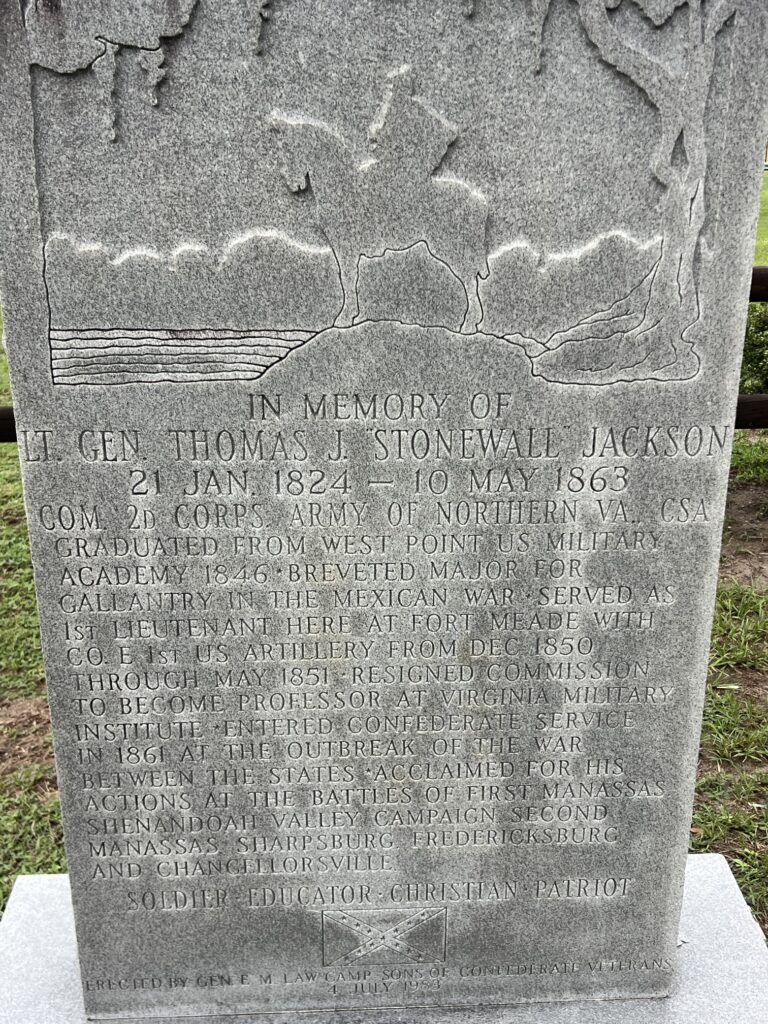
He resigned his commission not long after leaving Florida. He became a professor at the Virginia Military Institute, known to cadets as a stiff, humorless man who taught artillery tactics with the same flat intensity he likely brought to a Florida garrison post. Students mocked him behind his back.
Then came 1861. The war between the states broke out, and the professor entered Confederate service. Within months, at the First Battle of Manassas, another officer pointed to Jackson’s brigade holding firm against the Union advance and shouted that they stood like a stone wall.
The nickname followed him for the rest of his life, which turned out to be short. Both men were present at Chancellorsville in May 1863, Meade commanding the Union V Corps, Jackson leading Lee’s 2nd Corps for the Confederacy. Jackson was struck down by his own men in the confusion of that same battle, on the night of May 2, before the two units ever collided directly. He died of complications on May 10, 1863.
Wikipedia’s entry on Fort Meade, Florida, confirms both men’s postings here, along with a detail few visitors know. A mounted volunteer company nicknamed the “Hickory Boys” formed at the fort around the start of the Civil War, and the town itself was later burned by Union forces in 1864. The soldier and the site shared a fate that circled back on itself.
Legend says the two men never spoke of Florida again once the war began. There is no letter, no diary entry, no known account of either man mentioning Fort Meade once they became enemies. Perhaps it simply was not worth remembering. Perhaps a swampy outpost in the middle of the Seminole Wars felt too small to matter once they were leading armies of tens of thousands.
The Fort Meade Florida Historical Marker Today
What remains is the marker. Planted in the grass near where the fort once stood, easy to miss if you are not looking for it. It does not mention the irony. It does not need to. The stone lets the dates speak. Built in 1849. Garrisoned through the Seminole conflict. Two lieutenants, one after the other, learning the same terrain, walking paths that would one day lead them to opposite sides of the bloodiest war in American history.
We find something unsettling in that kind of coincidence. Not a ghost story. Not a haunting. Just the plain, cold fact that history sometimes rehearses itself in quiet places before the real performance begins. Fort Meade never knew what it was training. It just processed one officer after another, indifferent to what they would become.
Today the marker stands in Heritage Park, a city park in downtown Fort Meade, the site folded quietly into modern parkland. Spanish moss hangs over it now. Families walk past on their way to the playground and the open field beyond. Few of them stop to read every word.
Fort Meade was never the only outpost along that stretch of the Peace River doing this kind of quiet, forgotten work. Fort Fraser was built along the same military corridor, part of the same chain of forts strung across the Florida frontier during the Seminole Wars, and it carries its own story of names now mostly forgotten.
But if you do stop here, if you stand there long enough, you start to understand what makes Florida’s history different from the version taught in most classrooms. It is not always the battles fought here. It is the men who passed through on their way to becoming something else, something the state itself never got to witness.
Fort Meade built no monuments to either general. It didn’t need to. It built the men instead, and then it let them go.
Sources:
- Historical Marker Database, “Lt. Gen. Thomas J. ‘Stonewall’ Jackson Memorial,” hmdb.org
- Legends of America, “Fort Meade, Florida Military Post,” legendsofamerica.com
- Wikipedia, “Fort Meade, Florida”
Sources verified where possible. If you know more about Fort Meade’s role in Florida’s Seminole Wars, we want to hear it.